
What Size Air Purifier Do You Need for Kitchen Smoke?
For an enclosed kitchen, match the smoke CADR to about two-thirds of its square footage, per AHAM and EPA sizing charts, then size up toward a 1:1 ratio for frequent frying or wok cooking. If the kitchen opens into a living area, size for that whole combined space instead, since HEPA alone will not clear cooking odors.
Key takeaways
- Use the same two-thirds smoke-CADR rule that works for any room, from AHAM and the EPA’s air cleaner chart — then size up toward a 1:1 CADR-to-square-foot ratio, as a rule of thumb, for frequent frying, wok cooking, or grilling.
- If your kitchen is open to a living or dining area rather than closed off by a door, the EPA says directly to size for the entire connected space, not just the kitchen’s own footprint.
- A true HEPA filter only removes particles. The EPA names cooking as a source of indoor pollutants and classes those pollutants as either particles or gases, including VOCs — so a kitchen purifier needs an activated carbon filter for the gas-phase half of the problem, not HEPA alone.
- A range hood or exhaust fan venting to the outdoors is still the first line of defense. The EPA’s general VOC guidance is to increase ventilation during the activity that creates the pollutants, which for a kitchen means running the hood while you cook, not instead of a purifier.
- There’s no official minimum carbon weight for a kitchen purifier — the EPA says only that a carbon filter works better with more material in it, so compare carbon amount between models rather than looking for one certified number.
How much CADR does a kitchen actually need?
Start from the same baseline used for any room. The Association of Home Appliance Manufacturers’ (AHAM) two-thirds rule says to multiply the room’s square footage by two-thirds and look for at least that smoke Clean Air Delivery Rate (CADR) — the rating for how many cubic feet of filtered air a unit delivers per minute, tested separately for smoke, dust, and pollen. The EPA’s Guide to Air Cleaners in the Home publishes a matching chart built around an 8-foot ceiling: a 100-square-foot room needs a minimum smoke CADR of about 65, a 200-square-foot room about 130, and a 300-square-foot room about 195.
A kitchen used for light cooking — boiling, steaming, the occasional low-heat sauté — fits this standard two-thirds baseline reasonably well. A kitchen used for frequent frying, wok cooking, or grilling produces a heavier smoke and grease-aerosol load, closer to what AHAM addresses with its separate 1:1 recommendation for wildfire-smoke conditions: a smoke CADR equal to the full square footage, not two-thirds of it. Cooking smoke is not wildfire smoke, and AHAM does not publish a cooking-specific ratio, but matching that heavier 1:1 target is a reasonable rule of thumb for a kitchen where high-heat cooking happens most days, rather than an official standard.
For the full room-by-room comparison, including bedrooms, basements, and other spaces, see the air purifier size by room guide.
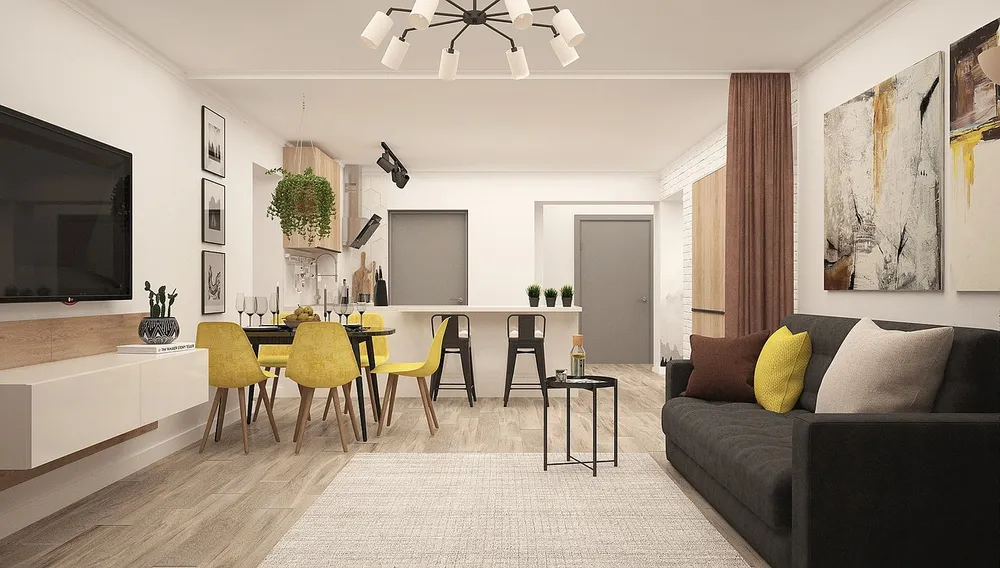
Does an open-plan kitchen need a bigger purifier?
Yes, and the EPA is direct about why: its own sizing guidance tells homeowners with an open floor plan to size for the entire connected space the unit will actually serve, not just one room within it. A kitchen with a doorway and walls contains cooking smoke and odor in a defined volume of air. A kitchen that opens straight into a living room or dining area shares that air across the whole connected footprint, so sizing only for the kitchen’s own square footage will leave a unit undersized for the actual space it has to clean.
In practice, that means adding up the kitchen’s square footage plus the connected living or dining area it opens into, then applying the same two-thirds (or 1:1, for heavy cooking) target to that combined number — not a separate formula, just a bigger square-footage input to the same chart. If your kitchen is part of a larger open floor plan with multiple distinct zones, also see one big air purifier or two small ones for an open floor plan for when a single unit stops being the right answer.
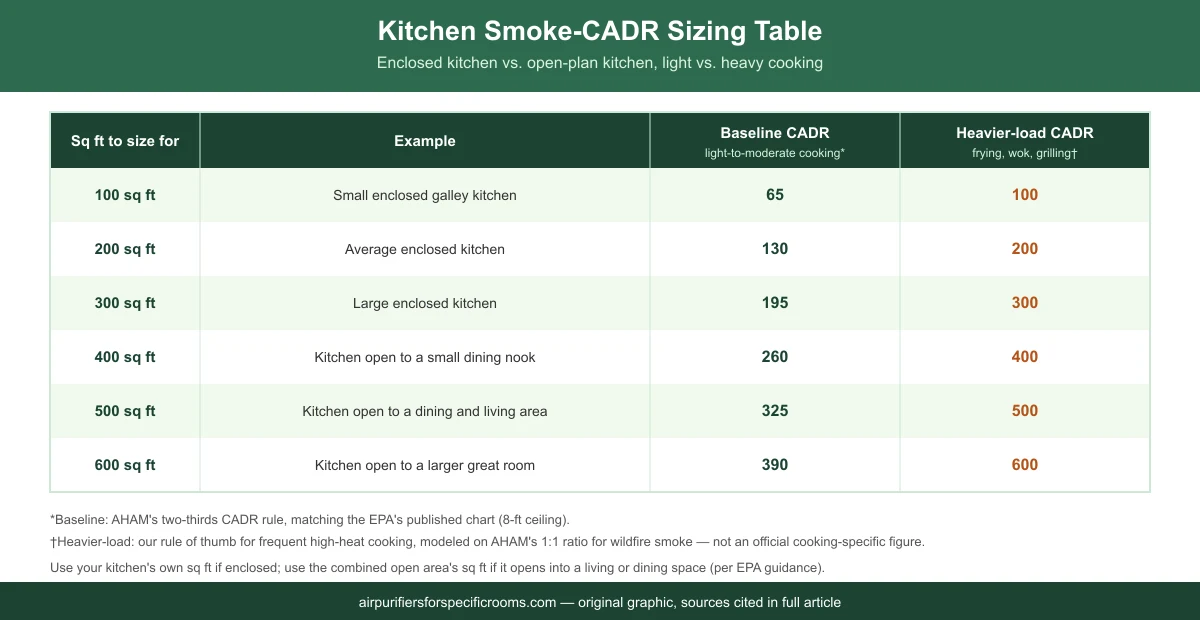
The kitchen smoke-CADR sizing table
This table applies the same EPA and AHAM math to both situations: find the square footage you’re actually sizing for — your kitchen alone if it’s a closed room, or the kitchen plus the connected open area if it isn’t — then read across to the light-cooking and heavy-cooking targets.
| Square footage to size for | Example | Baseline CADR (light-to-moderate cooking)* | Heavier-load CADR (frequent frying, wok, grilling)† |
|---|---|---|---|
| 100 sq ft | Small enclosed galley kitchen | 65 | 100 |
| 200 sq ft | Average enclosed kitchen | 130 | 200 |
| 300 sq ft | Large enclosed kitchen | 195 | 300 |
| 400 sq ft | Kitchen open to a small dining nook | 260 | 400 |
| 500 sq ft | Kitchen open to a dining and living area | 325 | 500 |
| 600 sq ft | Kitchen open to a larger great room | 390 | 600 |
*Baseline smoke CADR from AHAM’s two-thirds rule, matching the EPA’s published chart, calculated on an 8-foot ceiling. Size up further for a taller or vaulted ceiling. †The heavier-load column is our own rule of thumb for kitchens with frequent high-heat cooking, modeled on AHAM’s published 1:1 CADR-to-square-foot ratio for wildfire-smoke conditions — it is not an official cooking-specific AHAM or EPA number.
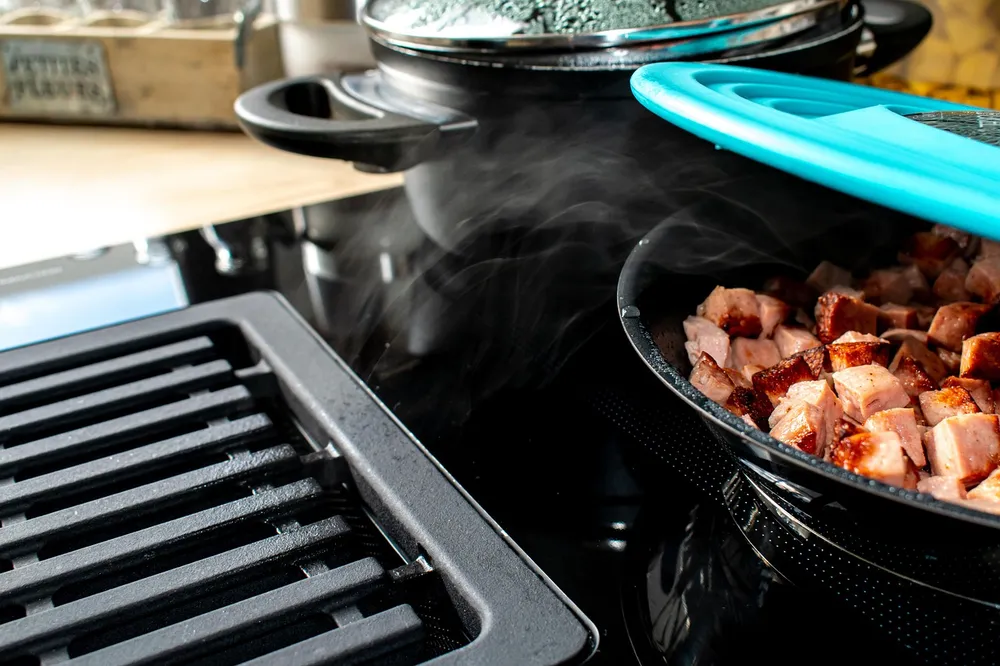
Why won’t a HEPA filter alone clear cooking odors and VOCs?
Because HEPA only catches particles, and a kitchen’s problem is not only particles. The EPA’s Guide to Air Cleaners in the Home points out that most filters are built to handle either particles or gases, not both — which is why many air cleaners pair two separate filter stages rather than relying on one. A true HEPA filter is a particle filter: it is very good at capturing the solid smoke and grease aerosol that frying and grilling throw into the air. It does essentially nothing for the gas-phase compounds — including volatile organic compounds, or VOCs — that make up a lingering cooking smell long after the visible smoke has cleared.
The EPA frames the whole category plainly: “Indoor air contains pollutants that can affect human health. Some of these pollutants come from outdoors, and others come from indoor sources and activities, such as cooking, cleaning, secondhand smoke, building materials, consumer products, and home furnishings. These indoor air pollutants can be particles or gases, including volatile organic compounds (VOCs).” Cooking sits right alongside cleaning and secondhand smoke as a named source — and like those, it contributes both the particles a HEPA filter is built to catch and the gases it is not.
To actually reduce the gas-phase half of that load, the EPA recommends choosing a portable air cleaner with an activated carbon filter, or another absorbent filter built to remove gases, alongside the particle filter. Fried food, oil heated past its smoke point, and charred or seared surfaces all give off more of these VOCs than boiling or steaming does, which is part of why a kitchen purifier benefits from a real carbon stage even when a bedroom or nursery purifier might not need one as much.
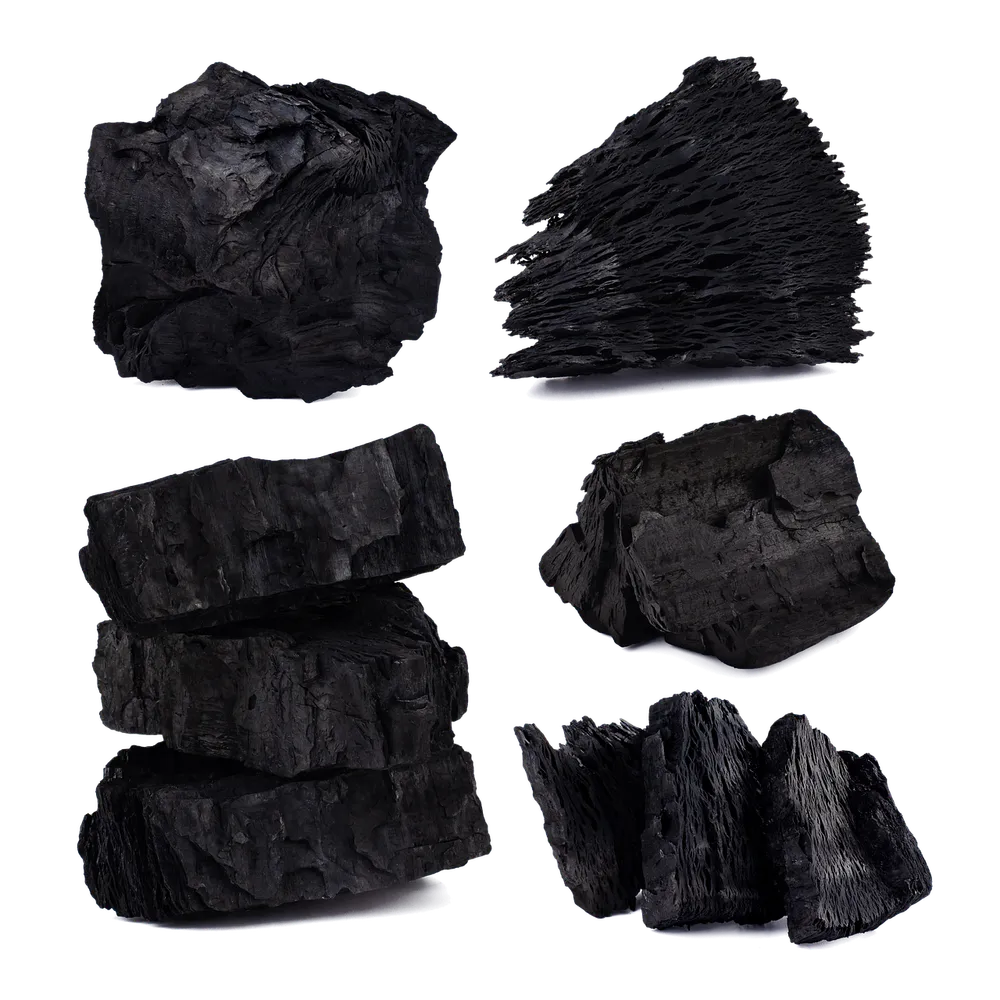
How much activated carbon is actually enough?
There is no widely published minimum. The EPA notes that, unlike CADR for particle filters, there is no widely used performance rating system for a gas-removing or carbon filter’s effectiveness — the agency’s practical guidance is simply that a carbon filter works better with a larger amount of material in it, and a thicker bed of carbon outperforms a thin one. In practice, that means comparing the carbon stage between models rather than trusting a single marketing number: a thin carbon-coated sheet wrapped around a HEPA filter is a different thing from a dedicated carbon filter with real depth and weight to it, even if both are labeled as having activated carbon.
It also means a carbon filter wears out faster in a kitchen than it would in a bedroom, since grease and odor compounds load it up continuously. Follow the manufacturer’s replacement schedule for that specific model, and expect to replace a kitchen unit’s carbon stage more often than the CADR-rated particle filter.
Should I run the range hood, the purifier, or both?
Both, and in that order. A range hood or exhaust fan that vents to the outdoors removes smoke, grease aerosol, steam, and gases at the source, before they spread through the kitchen at all — a portable purifier only filters air that has already escaped into the room. The EPA’s general advice for VOC-emitting activities is to increase ventilation while the activity is happening, which for cooking means turning the hood on before you start and leaving it running a few minutes after you finish, not just when something visibly smokes.
A purifier earns its place for everything the hood misses: odor and fine particles that drift past the hood’s capture zone, a stovetop without a vented hood at all, or the minutes right after cooking when lingering VOCs are still raised. Running both together, sized to the table above, covers more of the problem than either one alone.
Where should a kitchen air purifier go?
Give it open space on at least two sides so it can pull air in and push filtered air back out, away from the stove itself — close enough to treat the room, but not so close that grease aerosol coats the intake and clogs the filter faster than normal. A spot a few feet from the cooking surface, on a counter or stand rather than tucked into a corner cabinet, works for most kitchens. If the kitchen is part of an open floor plan, placing the unit nearer the cooking side of the space, rather than at the far end of the connected living area, puts it closer to where the pollutant load actually starts.
Frequently asked questions
What size air purifier do I need for a small kitchen?
For a 100-square-foot enclosed kitchen with light-to-moderate cooking, look for a smoke CADR of at least about 65, per the AHAM and EPA two-thirds rule. If you fry or wok-cook often in that same space, size up toward a smoke CADR around 100 instead, using the heavier-load column in the table above.
Does an air purifier remove cooking smells, or just smoke?
It depends on the filter. A true HEPA filter removes the visible smoke particles well but does little for the gas-phase compounds behind a lingering smell. The EPA’s guidance is to add an activated carbon filter specifically to address gases, including the VOCs that make up most of a cooking odor once the smoke itself has cleared.
Can I use the same air purifier for my kitchen and living room?
Yes, if the two spaces are open to each other and you size the unit for their combined square footage, per the EPA’s open-floor-plan guidance above.
Is it safe to run an air purifier while cooking with a gas stove?
A standard HEPA-and-carbon air purifier is designed to run continuously in a kitchen and is not itself a safety concern. It is not a substitute for a range hood or exhaust fan, though — ventilating combustion byproducts outdoors is a separate job from filtering the air that’s already in the room, and the hood should still run whenever the stove is on.
How often should I replace the carbon filter in a kitchen air purifier?
Follow the manufacturer’s schedule for that specific model, and expect to replace it sooner than you would in a bedroom or office. Grease aerosol and cooking VOCs load a carbon filter faster than everyday household dust does, so a kitchen unit’s carbon stage typically needs attention more often than its particle filter.
Sources
- U.S. Environmental Protection Agency, Guide to Air Cleaners in the Home — the CADR-by-square-footage chart, the open-floor-plan sizing guidance, the particles-vs-gases filter distinction, the statement naming cooking as an indoor pollutant source, and the activated carbon guidance.
- U.S. Environmental Protection Agency, Volatile Organic Compounds’ Impact on Indoor Air Quality — the general guidance to increase ventilation during the activity that generates VOCs.
- Association of Home Appliance Manufacturers (AHAM), Tips for Choosing the Ideal Portable Room Air Cleaner — the two-thirds CADR rule and the 1:1 ratio recommended for wildfire-smoke conditions.
airpurifiersforspecificrooms.com Editorial Team. Last updated: November 12, 2026.

Related Posts
How to Size an Air Purifier for a Vaulted Ceiling Room
What Size Air Purifier Do You Need for a Garage Workshop?