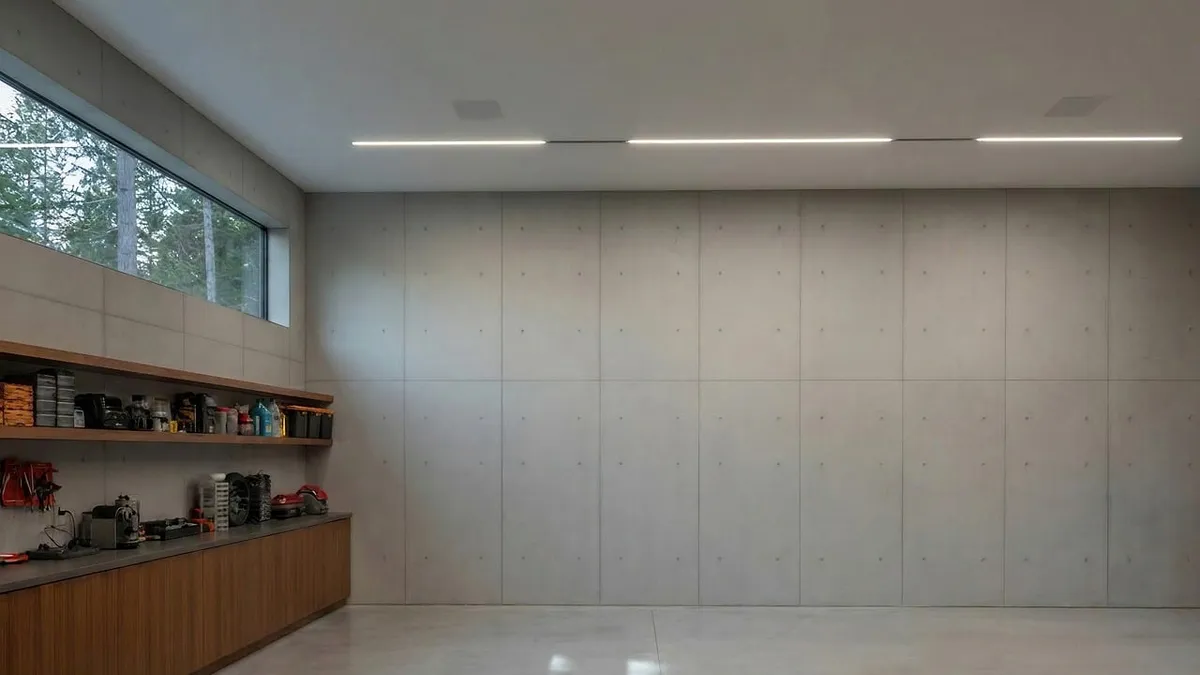
What Size Air Purifier Do You Need for a Garage Workshop?
For a two-car garage used mainly for sawdust, match a dust/smoke CADR to about two-thirds of its square footage, per AHAM and EPA sizing charts. For paint, stain, or solvent fumes, size up toward a 1:1 CADR ratio and add a heavy activated-carbon filter — HEPA alone does not remove VOCs, and ventilation matters more than filtration for flammable vapors.
Key takeaways
- Use the same two-thirds CADR rule as any room for a sawdust-only garage, per AHAM and the EPA’s sizing chart — then size up toward a 1:1 CADR-to-square-foot ratio, as a rule of thumb, once paint, stain, or solvent fumes are part of the picture.
- A true HEPA filter only removes particles like sawdust. The EPA draws a hard line between particle filters and gas filters — a garage used for painting, staining, or finishing needs a real activated-carbon stage, not HEPA alone.
- Sawdust is a fire and explosion hazard, not just an air-quality one. OSHA’s woodworking guidance calls for dust collection at the source on every machine that produces it — a portable purifier supplements that, it never replaces it.
- Solvent and paint vapors carry their own flammability risk. OSHA’s spray-finishing ventilation standard is built around diluting solvent vapor with fresh-air exhaust, not filtration — keep a door or window open and run an exhaust fan whenever you use flammable finishes, purifier or not.
- There’s no official minimum carbon weight for a shop purifier. The EPA says only that more carbon material works better, so compare the actual carbon bed between models rather than trusting one marketing number.
How much CADR does a garage need for sawdust alone?
Start from the same baseline used for any room. The Association of Home Appliance Manufacturers’ (AHAM) two-thirds rule says to multiply a room’s square footage by two-thirds and look for at least that smoke Clean Air Delivery Rate (CADR) — the rating for how many cubic feet of filtered air a unit delivers per minute. The EPA’s Guide to Air Cleaners in the Home publishes a matching chart, built around an 8-foot ceiling: a 400-square-foot room needs a minimum CADR of about 260, a 500-square-foot room about 325, and a 600-square-foot room about 390.
Sawdust particles are generally coarser than the smoke particles this chart is built around, so a purifier sized to the published smoke-CADR target comfortably covers dust too — this is our own reasoning applied to the EPA’s chart, not a sawdust-specific EPA or AHAM figure. If a garage has a workbench and hand tools but no power sanders, routers, or table saws running regularly, this baseline is a reasonable starting point.
For the full room-by-room comparison, including bedrooms and kitchens, see the air purifier size by room guide.

Does painting, staining, or finishing change the sizing?
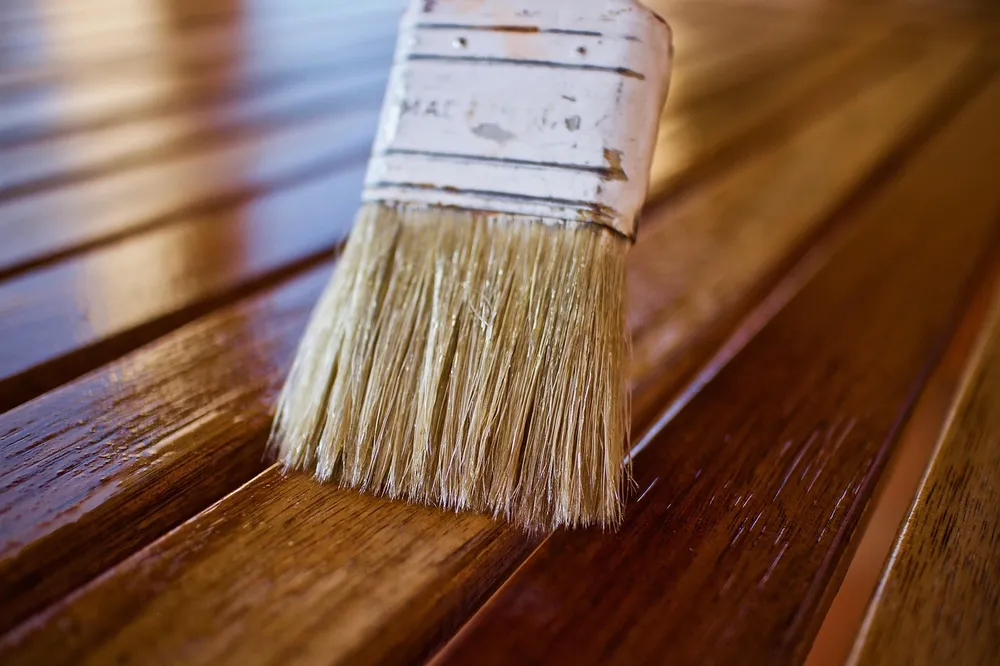
Yes, in two separate ways. First, the pollutant itself changes: paint, stain, varnish, and many adhesives and solvents are sources of volatile organic compounds (VOCs), which the EPA names specifically — “paints, paint strippers and other solvents” and “wood preservatives” are both listed among common household VOC sources. A true HEPA filter is a particle filter; it does essentially nothing for gas-phase VOCs. The EPA’s guide is direct about the fix: “to filter gases, choose a portable air cleaner with an activated carbon filter or other filter designed to remove gases.”
Second, the sizing target itself goes up. AHAM publishes a higher 1:1 ratio — CADR equal to the full square footage, not two-thirds of it — specifically for wildfire-smoke conditions, where the pollutant load is unusually heavy. A garage with fresh paint, stain, or solvent use is not a wildfire-smoke scenario, and neither AHAM nor the EPA publishes a fumes-specific ratio, but matching that heavier 1:1 target is a reasonable rule of thumb any time you’re actively painting, staining, or using strong solvents — not an official standard.
The garage and workshop sizing table
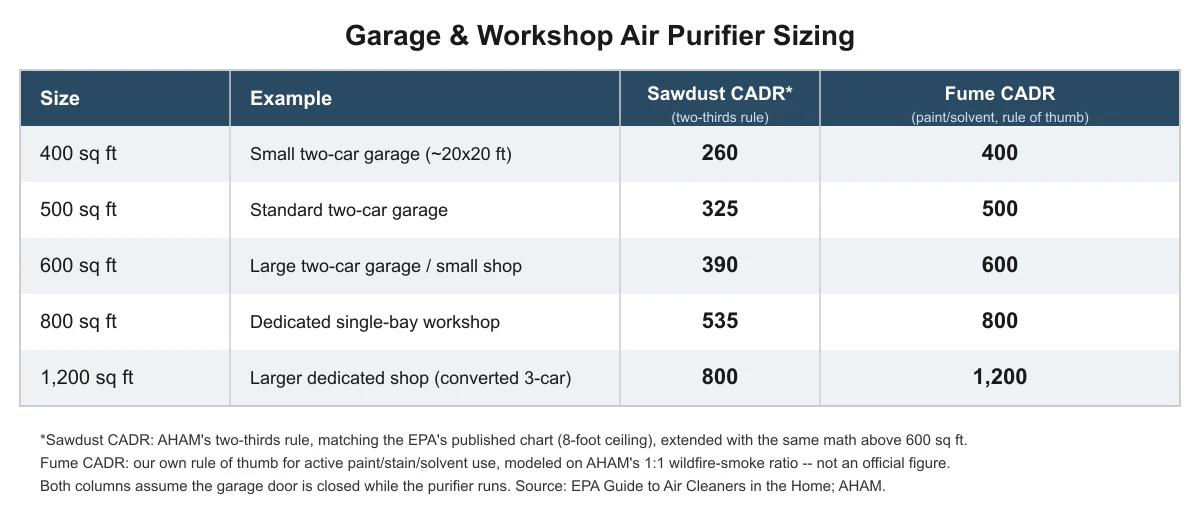
Find your garage or shop’s square footage, then read across to the sawdust-only target and the heavier paint/solvent-fume target. A unit sized for the fume column will also cover sawdust, since it asks for more CADR, not less.
| Garage or shop size | Example | Sawdust-only CADR target (two-thirds rule)* | Paint/solvent-fume CADR target (heavier rule of thumb)† |
|---|---|---|---|
| 400 sq ft | Small two-car garage (about 20 x 20 ft) | 260 | 400 |
| 500 sq ft | Standard two-car garage | 325 | 500 |
| 600 sq ft | Large two-car garage or small dedicated shop | 390 | 600 |
| 800 sq ft | Dedicated single-bay workshop | 535 | 800 |
| 1,200 sq ft | Larger dedicated shop (e.g., a converted three-car garage) | 800 | 1,200 |
*Baseline CADR from AHAM’s two-thirds rule, matching the EPA’s published chart up to 600 sq ft and calculated the same way beyond it, on an 8-foot ceiling. Size up further for a taller shop ceiling. †The fume column is our own rule of thumb for garages and shops with active paint, stain, or solvent use, modeled on AHAM’s published 1:1 CADR-to-square-foot ratio for wildfire-smoke conditions — it is not an official fume-specific AHAM or EPA number. Both columns assume the garage door is closed while the purifier runs; sizing math does not apply to a space with the door open to the outdoors.
Why is sawdust more than just a nuisance?
Because it is a fire hazard as well as a respiratory one. OSHA’s woodworking safety guidance is blunt about the fire risk: “sawdust…will ignite and burn far more easily than whole pieces of lumber,” and sanders, routers, and shapers in particular throw off large amounts of fine dust that can accumulate on rafters and other surfaces out of sight. OSHA’s primary recommended control is local exhaust ventilation (LEV) — a dust collector or shop vacuum hooked directly to each tool that produces dust — plus general ceiling-mounted exhaust for whatever escapes that source collection, and regular housekeeping since some dust always does.
Wood dust is also a documented respiratory hazard on its own. OSHA’s guidance lists “asthma, hypersensitivity pneumonitis, and chronic bronchitis” among the respiratory effects of wood dust exposure, along with skin and eye irritation and nasal dryness, and sets a permissible exposure limit of 15 mg/m³ total dust (5 mg/m³ respirable) as an 8-hour time-weighted average for occupational settings. A portable air purifier is a reasonable supplement for the dust that gets past your dust collector and lingers in the room — it is not a substitute for source collection at the tool itself, and OSHA’s guidance explicitly warns against using compressed air to blow dust off surfaces, since that just creates a dust cloud rather than removing the hazard.
How should I ventilate when using paint, stain, or solvents?
With real outdoor airflow, not just a purifier. The EPA’s general VOC guidance is to increase ventilation during the activity that generates the fumes: “if a label says to use the product in a well-ventilated area, go outdoors or in areas equipped with an exhaust fan to use it. Otherwise, open up windows to provide the maximum amount of outdoor air possible.” For a garage, that means the garage door open (or at least a window and an exhaust fan) whenever you’re painting, staining, or using solvent-based products — not just when the smell becomes noticeable.
This is a flammability issue as well as an air-quality one. OSHA’s spray-finishing ventilation standard (29 CFR 1910.94), written for industrial spray booths, requires exhaust volume high enough to dilute solvent vapor to no more than 25% of its lower explosive limit, with fresh make-up air supplied to replace whatever is exhausted. A home garage doing occasional brush-on staining isn’t running an industrial spray booth, but the underlying principle holds: a flammable vapor concentration is a ventilation problem, and an air purifier’s carbon filter is not tested or rated to solve it. Treat cross-ventilation as the safety requirement and the purifier as the air-quality improvement that runs alongside it, never in place of it. Keep solvents and finishing rags away from any ignition source — pilot lights, wall heaters, or a running vehicle — while fumes are present.
Can one purifier handle both sawdust and fumes?
Usually, yes, if you pick the right filter combination and size for the heavier of your two loads. A single unit with a true HEPA stage for particles and a substantial activated-carbon stage for gases covers most home-shop use, as long as it’s sized to the fume column in the table above whenever you also paint or finish in the same space. The EPA notes there’s no widely used performance rating for a carbon filter the way CADR rates particle removal — its practical guidance is simply that a thicker bed of carbon outperforms a thin one, so compare the actual carbon amount between models rather than a single marketing claim.
Expect the carbon stage to need replacement more often than the HEPA stage in a shop that sees regular solvent use, since gas-phase compounds load it continuously. Follow the manufacturer’s replacement schedule for your specific model. And remember that all of this sizing math assumes a reasonably enclosed space — a garage with the big door open to the outdoors is not a sealed room, and no CADR number accounts for that much open-air exchange.
Where should a garage or workshop air purifier go?
Give it open space on at least two sides, away from the direct path of a table saw, sander, or spray area, so sawdust or overspray doesn’t coat the intake and clog the filter faster than normal. A spot a few feet off the floor — a shelf or stand rather than directly on a dusty concrete slab — keeps the intake out of the heaviest settled dust layer. If the shop has a separate finishing area from the main cutting and sanding area, placing the unit between the two, or running two smaller units, treats both zones better than one unit in a corner far from either.
For sizing guidance in a related space, see the how to size an air purifier for a musty basement guide, or for an all-day occupied small space, see our home office sizing guide.
Frequently asked questions
What size air purifier do I need for a two-car garage?
For a 400-500 square foot two-car garage used mainly for sawdust, look for a CADR of about 260-325, per the AHAM and EPA two-thirds rule. If you also paint, stain, or use solvents in that same space, size up toward a CADR of 400-500 instead, and make sure the unit has a real activated-carbon stage, not HEPA alone.
Will a HEPA air purifier remove paint or solvent fumes?
No, not on its own. A true HEPA filter only removes particles. The EPA’s guidance is clear that gases, including the VOCs in paint, stain, and solvents, need an activated carbon filter or another gas-removing filter alongside the HEPA stage.
Is it safe to run an air purifier while using solvent-based paint or stain in a garage?
A standard HEPA-and-carbon air purifier is not itself a flammability hazard, but it is not a substitute for ventilation. Keep the garage door, a window, or an exhaust fan open to the outdoors whenever you’re using flammable solvents, per EPA and OSHA ventilation guidance — the purifier supplements that airflow, it doesn’t replace it.
Can sawdust buildup in a garage be a fire hazard?
Yes. OSHA’s woodworking guidance warns that sawdust ignites and burns far more easily than solid lumber, and that fine dust from sanders and routers can accumulate out of sight on rafters and other surfaces. Source-level dust collection on each tool, plus regular housekeeping, is the primary control — a portable air purifier is a supplement, not a replacement for it.
How often should I replace the carbon filter in a workshop air purifier?
Follow the manufacturer’s schedule for that specific model. A shop with regular solvent, paint, or stain use will load a carbon filter faster than one used only for sawdust, so expect to replace the carbon stage more often than the CADR-rated particle filter in a finishing-heavy garage.
Sources
- U.S. Environmental Protection Agency, Guide to Air Cleaners in the Home — the CADR-by-square-footage chart and the particles-vs-gases filter distinction, including the activated carbon recommendation.
- U.S. Environmental Protection Agency, Volatile Organic Compounds’ Impact on Indoor Air Quality — VOC sources including paints, solvents, and wood preservatives, and the guidance to ventilate during VOC-generating activities.
- Association of Home Appliance Manufacturers (AHAM), Tips for Choosing the Ideal Portable Room Air Cleaner — the two-thirds CADR rule and the 1:1 ratio recommended for wildfire-smoke conditions.
- Occupational Safety and Health Administration, Woodworking eTool: Fire and Explosion Hazards — sawdust combustibility and local exhaust ventilation controls.
- Occupational Safety and Health Administration, Sawmills eTool: Wood Dust Health Hazards — respiratory effects of wood dust and the OSHA permissible exposure limit.
- Occupational Safety and Health Administration, 29 CFR 1910.94, Ventilation — Spray Finishing — the requirement to dilute solvent vapor with fresh-air exhaust.
airpurifiersforspecificrooms.com Editorial Team. Last updated: November 12, 2026.

Related Posts
How to Size an Air Purifier for a Vaulted Ceiling Room

What Size Air Purifier Do You Need for a Home Office?