How to Size an Air Purifier for a Musty Basement
Before sizing a basement air purifier, find out whether the musty smell is just moisture or actual mold — the EPA is clear that air cleaners “do not address the cause of mold and musty odors,” so you have to fix the water problem first. Once that is underway, size the purifier to roughly 1.5-2x the normal two-thirds CADR target, as a rule of thumb for a basement’s low airflow, and never use an ozone generator in a damp space.
Key takeaways
- A musty smell is a symptom, not the problem. The EPA’s Brief Guide to Mold, Moisture and Your Home says plainly: “If you clean up the mold, but don’t fix the water problem, then, most likely, the mold problem will come back.”
- Use the troubleshooting table below to tell a moisture-only smell from one where spores are likely already airborne, before you shop for a purifier.
- The EPA’s Guide to Air Cleaners in the Home is direct about this: an air cleaner does not get at the cause of a mold or musty-odor problem. A purifier can help with airborne particles and some odor while you fix the source, but it is not a fix by itself.
- A basement’s low airflow and constant moisture make it a heavier load than a bedroom, so a rule-of-thumb oversize of about 1.5-2x the standard two-thirds CADR target is a reasonable starting point — this is not an official AHAM or EPA number, so treat it as a guideline, not a guarantee.
- Never run an ozone generator in a basement. The EPA has tested these devices and found that real-world units can produce ozone far above public health limits even when used exactly as directed, while doing little to actually remove indoor air contaminants at safe concentrations.
Is the smell moisture, or is mold already airborne?
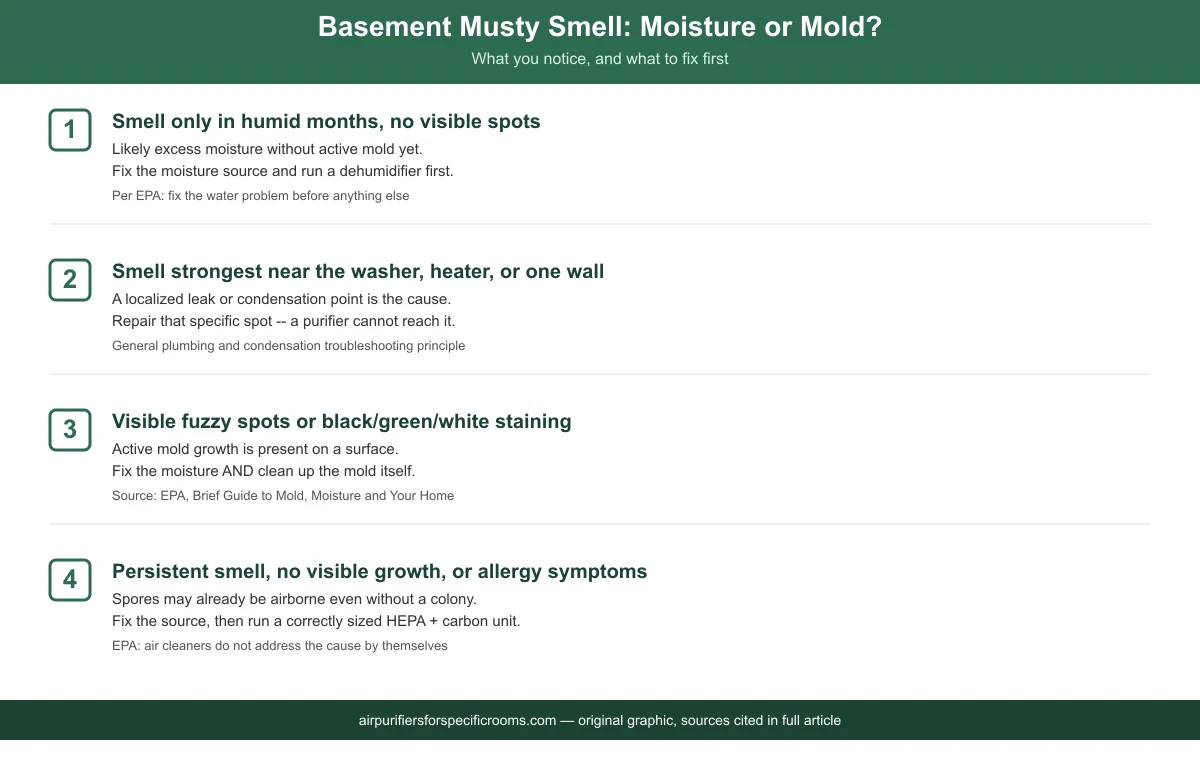
Basements get musty for different reasons, and the right first step depends on which one you have. Walk through the table below before buying anything.
| What you notice | What it usually means | What to do first |
|---|---|---|
| Musty smell only in humid months or after rain, no visible spots or stains | Excess moisture or humidity, without active mold growth yet | Fix the moisture source (sump pump, grading, foundation cracks) and run a dehumidifier; hold this off before adding a purifier |
| Smell is strongest near the washer, water heater, a window well, or one damp wall | A localized leak or condensation point | Find and repair that specific source — a purifier filters air across the room but cannot reach a wet spot behind a wall |
| Visible fuzzy spots, discoloration, or black/green/white staining on wood, drywall, carpet, or stored boxes | Active mold growth is present | Per the EPA, fix the moisture problem and clean up the mold itself (small areas: EPA’s own cleanup guidance; larger areas: a mold remediation professional) |
| Persistent musty smell with no visible growth, or sneezing/itchy eyes/congestion that eases when you leave the basement | Spores or microbial odor compounds may already be airborne, even without a visible colony | Address the moisture, consider professional testing if symptoms are strong, and run a correctly sized purifier to reduce the airborne and odor load while the source gets fixed |
Source for the EPA quotes and cleanup approach: EPA’s Brief Guide to Mold, Moisture and Your Home. This table is our own troubleshooting synthesis, not a quoted EPA table.
Why won’t a purifier fix the smell by itself?
Because it never touches the source. The EPA’s Guide to Air Cleaners in the Home is direct about this: an air cleaner does not get at the cause of a mold or musty-odor problem. Solving that problem means removing the moisture source and cleaning up the mold itself — something no amount of filtering can do. A purifier filters the air that is already in the room — it cannot dry out a damp foundation wall, seal a crack, or stop a leaking pipe.
That does not make a purifier useless in a basement. Once you are actively fixing the moisture problem, a correctly sized unit with both a HEPA filter and a real activated-carbon stage can reduce the airborne particle and odor load in the room while the underlying fix takes effect. Think of it as managing the air while the water problem gets solved, not as a replacement for solving it.
How much CADR does a basement actually need?
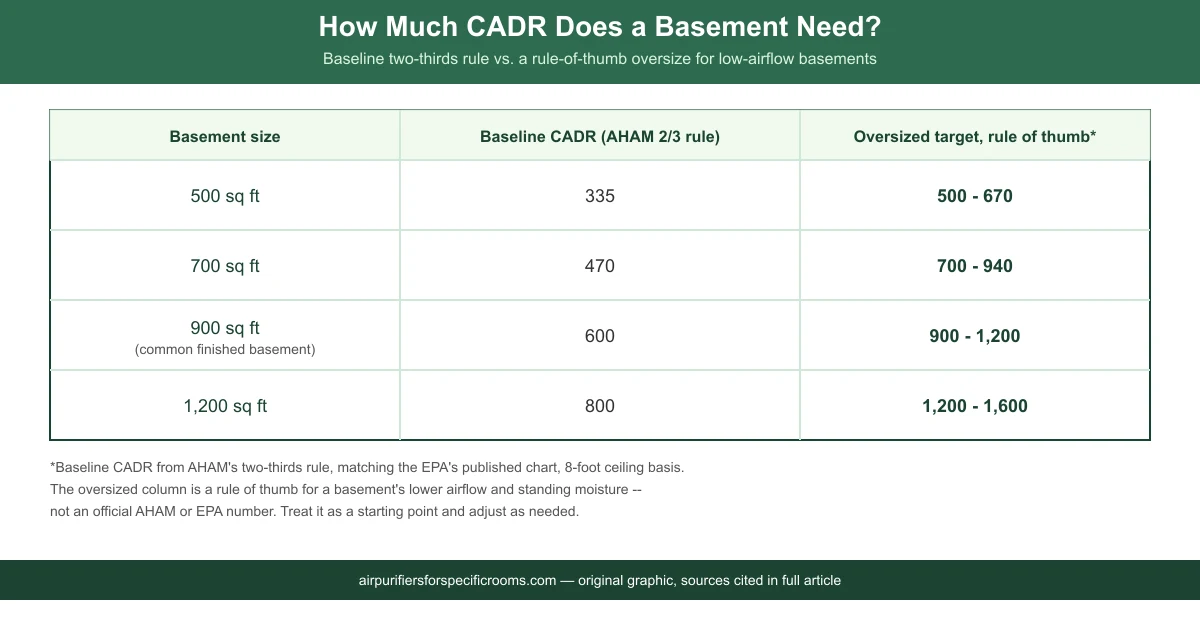
Start from the same baseline used for any room, then size up for a basement’s specific conditions. The Association of Home Appliance Manufacturers’ (AHAM) two-thirds rule says to multiply a room’s square footage by two-thirds and look for at least that smoke CADR (Clean Air Delivery Rate). AHAM also publishes a higher 1:1 ratio — CADR equal to the full square footage — specifically for wildfire-smoke conditions, where the pollutant load is unusually heavy.
A basement is not a wildfire-smoke scenario, but it shares some of the same reasons for sizing up: most basements have little or no return-air duct pulling air through the HVAC system, doors are often kept closed, and there is a standing moisture source feeding the odor. For that reason, a reasonable rule of thumb is to target roughly 1.5-2x the standard two-thirds number for a basement — this multiplier is our own rule of thumb, not an AHAM or EPA figure, so use it as a starting point and adjust based on how stubborn the smell actually is once the moisture is under control.
| Basement size | Baseline smoke CADR (AHAM two-thirds rule) | Rule-of-thumb oversized target for a damp, low-airflow basement* |
|---|---|---|
| 500 sq ft | 335 | 500-670 |
| 700 sq ft | 470 | 700-940 |
| 900 sq ft (common finished basement) | 600 | 900-1,200 |
| 1,200 sq ft | 800 | 1,200-1,600 |
*Baseline CADR from AHAM’s two-thirds rule, matching the EPA’s published chart, calculated on an 8-foot ceiling. The oversized column is not an official AHAM or EPA number — it is a rule of thumb reflecting a basement’s lower airflow and standing moisture source, loosely modeled on AHAM’s own 1:1, CADR-equal-to-room-size recommendation for heavy wildfire-smoke loads. If your basement has a vaulted or exposed-joist ceiling taller than 8 feet, size up further; see the EPA’s note on ceiling height below.
If your basement has an unusually tall or vaulted ceiling — some finished basements with exposed joists run higher than a standard 8 feet — size up again. The EPA’s guide notes that for ceilings taller than 8 feet, it is worth choosing an air cleaner sized for a bigger area than the floor-area number alone suggests.
What humidity level keeps the mold from coming back?
The EPA’s mold guidance for building professionals recommends keeping indoor relative humidity “below 60 percent — ideally between 30 percent and 50 percent, if possible.” A basement that regularly reads above that, especially in summer, is telling you the moisture problem is not actually fixed yet, no matter how the air purifier is performing.
A dehumidifier, not the purifier, is the tool that controls humidity. Run one sized for the room, empty or drain it regularly, and clean it periodically — a neglected dehumidifier reservoir can become its own damp, musty source. Pair it with basics like directing downspouts away from the foundation, grading soil away from the house, and making sure a bathroom or laundry exhaust fan in the basement actually vents outside rather than into a joist cavity.
Why should I never use an ozone generator in a basement?
Because the EPA has tested them and found the opposite of what they claim to do. At concentrations low enough to meet public health standards, the agency says ozone does very little to actually remove indoor air contaminants — including the compounds behind a musty smell. Worse, real-world use often exceeds those safe levels: one ozone generator rated for 3,000 square feet, run in a 350-square-foot room exactly as instructed, produced ozone readings “5-10 times higher than public health limits.”
Ozone itself is a lung irritant. The EPA warns that even relatively low amounts can cause chest pain, coughing, shortness of breath, and throat irritation, and that it can worsen chronic respiratory conditions such as asthma. A damp, often poorly ventilated basement is exactly the kind of enclosed space where those concentrations can build up. The EPA’s guide to air cleaners goes further, advising shoppers to avoid any portable air cleaner or furnace/HVAC filter designed to intentionally produce ozone, and notes that no federal agency has approved such devices for use in occupied spaces. Skip any product marketed as an ozone generator or ionic air sanitizer that lists ozone output as a feature, and choose a true HEPA-plus-carbon purifier instead.
Where should a basement air purifier be placed?
Keep it off the bare floor if the basement has ever flooded or stays damp near the slab — a small stand or shelf keeps the intake away from the most humid air layer and any standing moisture. Give it open space on at least two sides so it can pull air in and push filtered air out, away from stored boxes, furnace returns, or a sump pump pit. If the basement is split into a finished room and an unfinished mechanical area, place the purifier in the occupied space you actually spend time in, and keep the door to the unfinished area open enough for some air exchange rather than sealing the smell inside it.
When should I call in a professional instead?
Call a mold remediation contractor if visible mold covers more than a small patch, keeps returning after cleanup, or is hidden behind drywall, under carpet, or inside wall cavities you cannot safely open yourself. Call a foundation or waterproofing contractor if the moisture source is structural — a cracked foundation wall, a failing sump pump, or water actively coming through the walls or floor — since drying the air cannot fix a structural leak. An HVAC technician can help if the basement has no return duct at all and you are considering tying it into the home’s central system instead of relying on a portable unit.
For sizing in other rooms, see the air purifier size by room guide, or for a space with similar fume and odor concerns, see what size air purifier you need for a garage workshop.
Frequently asked questions
Can an air purifier get rid of a musty basement smell on its own?
Not by itself. The EPA is clear that air cleaners do not get at the cause of a mold or musty-odor problem. A purifier can reduce airborne particles and some odor while you are actively fixing the moisture source, but the smell will keep coming back if the water problem underneath it is never fixed.
What size air purifier do I need for a basement?
Start with AHAM’s two-thirds rule for your square footage, then consider sizing up to roughly 1.5-2x that baseline as a rule of thumb, since basements typically have little airflow and a standing moisture source. See the sizing table above for specific square-footage examples. This multiplier is a guideline, not an official AHAM or EPA number.
Is it safe to run an air purifier in a damp basement?
A standard HEPA-and-carbon air purifier is designed to run in normal indoor humidity and is not the safety concern — the concern is extreme dampness or standing water reaching the unit’s electrical components. Keep it off a wet floor and unplug it if the area floods. The device to avoid entirely in a damp space is an ozone generator, which the EPA warns against for any occupied room.
Should I run a dehumidifier or an air purifier first in a musty basement?
Address the moisture first. A dehumidifier (and fixing any leak or drainage issue) tackles the actual cause; an air purifier manages the air while that happens. Running a purifier alone in a consistently damp basement treats the symptom and lets the underlying moisture problem continue.
Are ozone generators safe for basement mold odors?
No. The EPA warns that ozone generators have produced indoor ozone levels far above public health limits even when used as instructed, that ozone is a respiratory irritant, and that no federal agency has approved these devices for occupied spaces. Choose a true HEPA-and-carbon air purifier instead.
Sources
- U.S. Environmental Protection Agency, Guide to Air Cleaners in the Home — statement that air cleaners do not address the cause of mold/musty odors, the ceiling-height sizing note, and the recommendation to avoid ozone-producing air cleaners.
- U.S. Environmental Protection Agency, Ozone Generators that Are Sold as Air Cleaners — health effects of ozone, the 3,000-sq-ft-rated unit tested in a 350-sq-ft room, and the statement that ozone has little potential to remove indoor air contaminants at safe concentrations.
- U.S. Environmental Protection Agency, A Brief Guide to Mold, Moisture, and Your Home — the need to fix the water problem and clean up mold together, and guidance on suspecting hidden mold from smell alone.
- U.S. Environmental Protection Agency, Mold Course, Chapter 2 — the recommended indoor relative humidity range of 30-50%, below 60%.
- Association of Home Appliance Manufacturers (AHAM), Tips for Choosing the Ideal Portable Room Air Cleaner — the two-thirds CADR rule and the 1:1 ratio recommended for wildfire-smoke conditions.
airpurifiersforspecificrooms.com Editorial Team. Last updated: November 12, 2026.

Related Posts
How to Size an Air Purifier for a Vaulted Ceiling Room
What Size Air Purifier Do You Need for a Garage Workshop?