What Size Air Purifier Do You Need for a Bedroom?
For most bedrooms, match the purifier’s smoke CADR to about two-thirds of the room’s square footage — a 200-square-foot bedroom needs roughly a 130 CADR, per AHAM’s and the EPA’s published sizing charts. Because you sleep in the room, also check the unit’s lowest fan-speed noise rating against WHO’s roughly 30 dB nighttime guideline.
Key takeaways
- Use the AHAM two-thirds rule: smoke CADR should be at least two-thirds of the bedroom’s floor area in square feet. The EPA’s Guide to Air Cleaners in the Home publishes a matching chart, built around an 8-foot ceiling.
- A bedroom’s defining sizing factor is noise, not pollutant load — you run it for hours while sleeping, so the fan speed that actually hits your CADR target matters as much as the CADR number itself.
- The World Health Organization’s Guidelines for Community Noise (1999) recommend an indoor bedroom target of 30 dB LAeq for continuous background noise and 45 dB LAmax for single sound events, to avoid disturbing sleep.
- AHAM’s own guidance says a properly sized unit is the best way to keep noise appropriate, because it can reach its target air changes per hour on a lower, quieter fan speed — an undersized unit forced onto its highest setting all night is usually the louder choice.
- A vaulted or high-ceilinged bedroom needs a higher CADR than the floor-area number alone suggests; see the ceiling-height guide below.
How much CADR does a bedroom actually need?
Three numbers decide this: the room’s square footage, its ceiling height, and the purifier’s Clean Air Delivery Rate (CADR) — a rating for how many cubic feet of filtered air a unit delivers per minute, tested separately for smoke, dust, and pollen.
AHAM’s two-thirds rule says to multiply square footage by two-thirds and look for a smoke CADR at least that high. The EPA publishes a nearly identical chart for the same purpose: a 100-square-foot room needs a minimum smoke CADR of about 65, a 200-square-foot room about 130, and a 300-square-foot room about 195, all calculated around a standard 8-foot ceiling.
A bedroom does not usually need the EPA and AHAM’s higher 1:1 “heavy load” sizing tier that applies to a smoky kitchen or a musty basement — everyday dust, pollen, and skin particles are a lighter, steadier load. The two-thirds baseline is the right starting point for most bedrooms.
Why does noise matter more in a bedroom than in other rooms?
You run a bedroom purifier all night, every night, right next to where you sleep. The World Health Organization’s Guidelines for Community Noise set an indoor bedroom target of 30 dB LAeq for continuous background noise and 45 dB LAmax for any single noise event, specifically to avoid disrupting sleep. That 30 dB figure is a guideline for overall bedroom noise, not a rule written for air purifiers specifically, but it is a reasonable target to check a unit’s lowest-speed noise rating against.
For scale, the EPA notes that a noise rating around 50 decibels is roughly the sound of a running refrigerator — noticeably louder than WHO’s 30 dB bedroom guideline, and a reminder that most appliances, including many air purifiers on anything above their lowest speed, run well above a “quiet sleep” level.
This is also why bigger is not automatically better. AHAM’s guidance states that choosing a properly sized unit is the best way to keep noise appropriate, because it can hit its target air changes per hour on a lower fan speed. A purifier that is too small for the room has to run at or near full speed all night just to keep up — and that is usually the louder setup, not the quieter one.
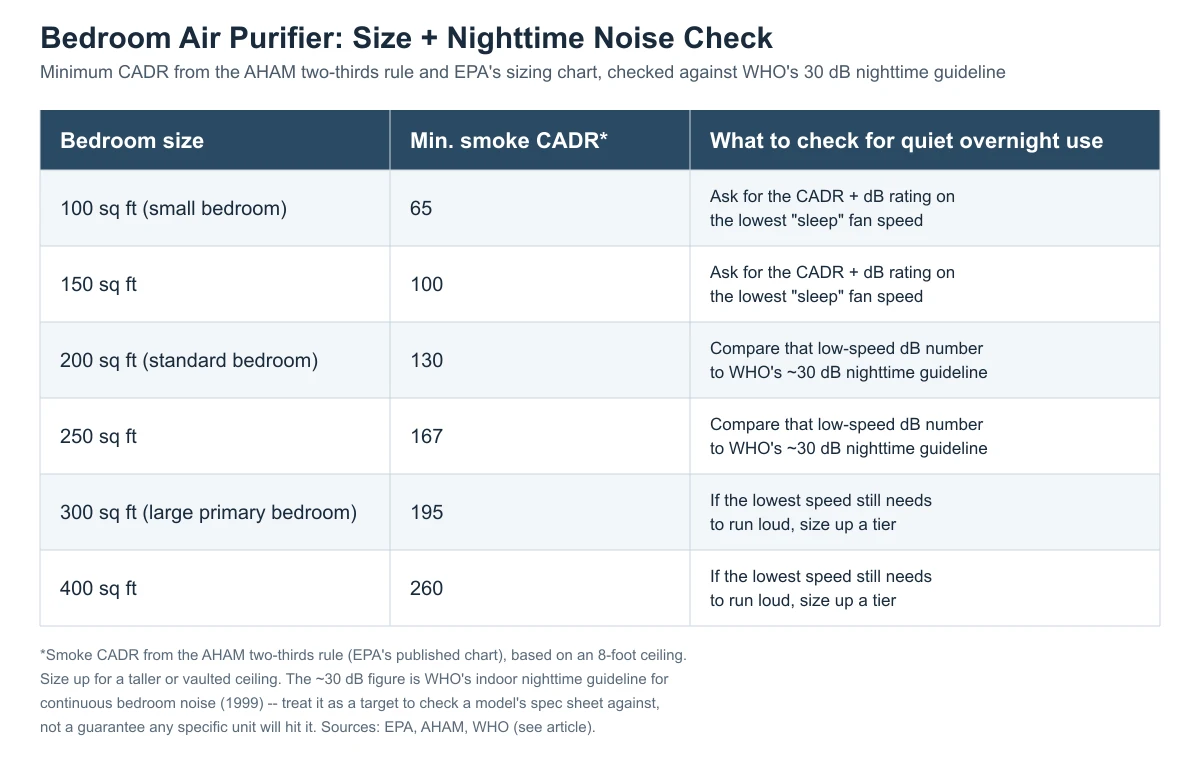
The bedroom size-and-noise decision table
This table combines the sizing chart and the noise check in one place, so you do not need to cross-reference a separate sizing guide and a separate noise guide.
| Bedroom size | Min. smoke CADR* | What to check for quiet overnight use |
|---|---|---|
| 100 sq ft (small bedroom) | 65 | Ask for the CADR and dB rating on the lowest “sleep” fan speed |
| 150 sq ft | 100 | Ask for the CADR and dB rating on the lowest “sleep” fan speed |
| 200 sq ft (standard bedroom) | 130 | Compare that low-speed dB number to WHO’s ~30 dB nighttime guideline |
| 250 sq ft | 167 | Compare that low-speed dB number to WHO’s ~30 dB nighttime guideline |
| 300 sq ft (large primary bedroom) | 195 | If the lowest speed still needs to run loud, size up a tier |
| 400 sq ft | 260 | If the lowest speed still needs to run loud, size up a tier |
*Smoke CADR from the AHAM two-thirds rule (matching the EPA’s published chart), based on an 8-foot ceiling. Size up for a taller or vaulted ceiling. The ~30 dB figure is WHO’s indoor nighttime guideline for continuous bedroom noise (1999) — treat it as a target to check a specific model’s spec sheet against, not a guarantee that any given unit will hit it, since manufacturers test and report low-speed noise differently.
How do I find a bedroom air purifier that runs quiet enough to sleep near?
Start with the CADR target in the table above for your room size, then check these three things on the product’s spec sheet before buying:
- Low-speed CADR, not just the top-speed number. A listing often advertises the highest CADR at full fan speed. Look for the CADR at the lowest or “sleep” setting too, since that is the speed you will likely run overnight.
- A published dB rating for that low speed. Not every brand lists this, but when it is available, compare it to WHO’s roughly 30 dB nighttime guideline above. A model that only publishes a single dB figure at top speed is not telling you what it sounds like on low.
- A dedicated “sleep” or “night” mode. Many purifiers dim their display lights and cap the fan at its lowest speed in this mode, which is the setting most relevant to a bedroom.
If the lowest speed on a unit sized to your exact square footage still feels too loud, the practical fix is to size up a tier: a purifier rated for the next size room up can often reach your required CADR on an even lower, quieter fan speed.
Where should a bedroom air purifier be placed?
Give it open space to pull air in and push filtered air out: a few feet from a wall or furniture that could block the intake or outlet vents, and not tucked inside a closet or directly behind a curtain. Placing it near the center of the room or along the wall closest to where you sleep, rather than in a far corner, helps filtered air reach you sooner. If you are sizing a purifier for a nursery instead of an adult bedroom, crib placement and distance add another safety layer — see how to size and place an air purifier in a nursery.
What if my bedroom has a vaulted or high ceiling?
Size up. The EPA and AHAM calculate their CADR charts around an 8-foot ceiling, and a taller ceiling means more total air volume for the same floor area. The EPA’s own guidance says to select a portable air cleaner with a higher CADR than the standard chart shows when ceilings are taller. For worked examples with specific vaulted-ceiling numbers, see how to size an air purifier for a room with a vaulted ceiling.
For the full room-by-room comparison, including basements, kitchens, and other spaces, see the air purifier size by room guide.
Frequently asked questions
Is it OK to run a bedroom air purifier on its highest setting all night?
It will clean the air, but it is usually the louder option. AHAM’s guidance notes that a properly sized unit can reach its target air changes per hour on a lower fan speed, which is the main reason sizing matters for noise. If your current unit only keeps up on its highest setting, it is likely undersized for the room rather than needing to run loud by design.
Does a higher CADR always mean a louder air purifier?
Not necessarily at the speed you actually use. A larger unit rated for a bigger room can often hit the same CADR your bedroom needs while running on a lower, quieter fan speed than a smaller unit pushed to its maximum. Check the low-speed CADR and dB rating specifically, rather than comparing only the top-speed numbers between models.
What decibel level should I look for in a bedroom air purifier?
There is no official decibel rule written specifically for air purifiers. The closest available reference is the World Health Organization’s general indoor bedroom guideline of about 30 dB LAeq for continuous noise, intended to avoid disrupting sleep. Use that as a target when comparing a purifier’s lowest-speed dB rating, keeping in mind manufacturers do not all measure or report it the same way.
Should I size my bedroom purifier for the whole room or just the area around the bed?
Size it for the whole room. A purifier filters the air in the space it occupies, and air circulates through the full room over time rather than staying confined to one corner. Use the room’s total square footage in the table above, not just the footprint of the sleeping area.
Sources
- U.S. Environmental Protection Agency, Guide to Air Cleaners in the Home — CADR-by-square-footage chart, 8-foot ceiling basis, ceiling-height adjustment, and the refrigerator noise-level reference.
- Association of Home Appliance Manufacturers (AHAM), Tips for Choosing the Ideal Portable Room Air Cleaner — the two-thirds CADR rule and the guidance that proper sizing is the best way to keep noise appropriate.
- World Health Organization, Guidelines for Community Noise (1999) — indoor bedroom guideline values of 30 dB LAeq for continuous noise and 45 dB LAmax for single events.
airpurifiersforspecificrooms.com Editorial Team. Last updated: November 12, 2026.

Related Posts
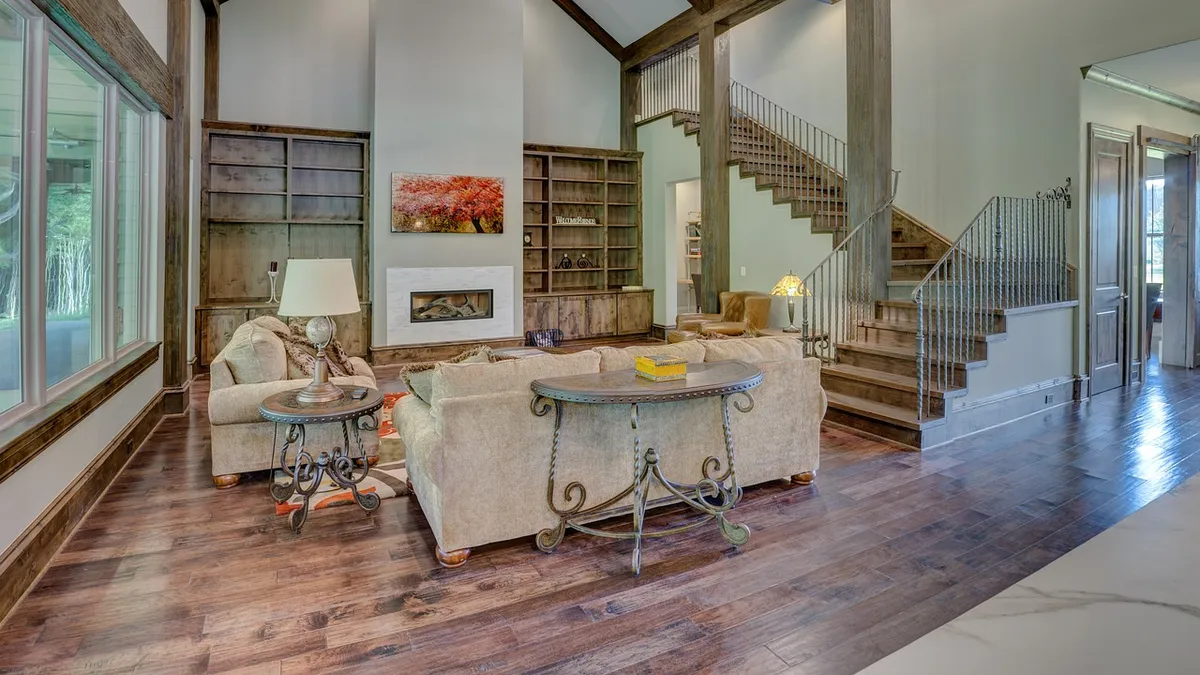
How to Size an Air Purifier for a Vaulted Ceiling Room
What Size Air Purifier Do You Need for a Garage Workshop?
One thought on “What Size Air Purifier Do You Need for a Bedroom?”