How to Size and Place an Air Purifier in a Nursery
Match the purifier’s smoke CADR to at least two-thirds of the nursery’s square footage (the AHAM standard), then place the unit on a stable low surface several feet from the crib — never on a shelf above it. Keep the cord at least 3 feet from the crib, per CPSC guidance, and skip ozone-generating models.
Key takeaways
- Size first: the Association of Home Appliance Manufacturers (AHAM) recommends a smoke CADR at least two-thirds of the room’s square footage — the same baseline used for any bedroom.
- Keep every cord, including the purifier’s own power cord, at least 3 feet from the crib. The U.S. Consumer Product Safety Commission (CPSC) gives this exact distance for baby monitor cords and any other cord near a crib, because of strangulation risk.
- Never use an ozone generator or an ionizing purifier that produces ozone in a nursery. The EPA says no federal agency has approved these devices for occupied spaces.
- For noise, aim under roughly 30 dB(A) on the lowest fan setting. That is the World Health Organization’s (WHO) guideline for good-quality sleep in a bedroom at night; treating daytime naps the same way is a reasonable rule of thumb, not a separate official figure.
- Placement is as much a safety question as a sizing one: a correctly sized unit on a stable, low surface, with airflow pointed away from the crib, does more good than an oversized unit shoved into a corner.
How do I size an air purifier for a nursery?
Start with the same baseline the EPA’s Guide to Air Cleaners in the Home and AHAM both publish: multiply the room’s square footage by two-thirds, and look for a smoke Clean Air Delivery Rate (CADR) at least that high. CADR measures how many cubic feet of filtered air a unit delivers per minute.
A nursery is usually a smaller, closed-door room, so the math stays simple:
| Nursery size | Minimum smoke CADR (two-thirds rule) |
|---|---|
| 100 sq ft | 67 or higher |
| 120 sq ft | 80 or higher |
| 150 sq ft | 100 or higher |
If the nursery has a vaulted or unusually high ceiling, both AHAM and the EPA note that the chart above assumes a standard 8-foot ceiling, so a taller room needs a higher CADR than its floor area alone suggests — the extra air volume has to be filtered too. If you are furnishing more than one room, our air purifier size by room guide compares the sizing math across eight common room types in one table, and our bedroom sizing guide walks through the same two-thirds rule for an adult bedroom.
Where should the air purifier go, and what about the cord?
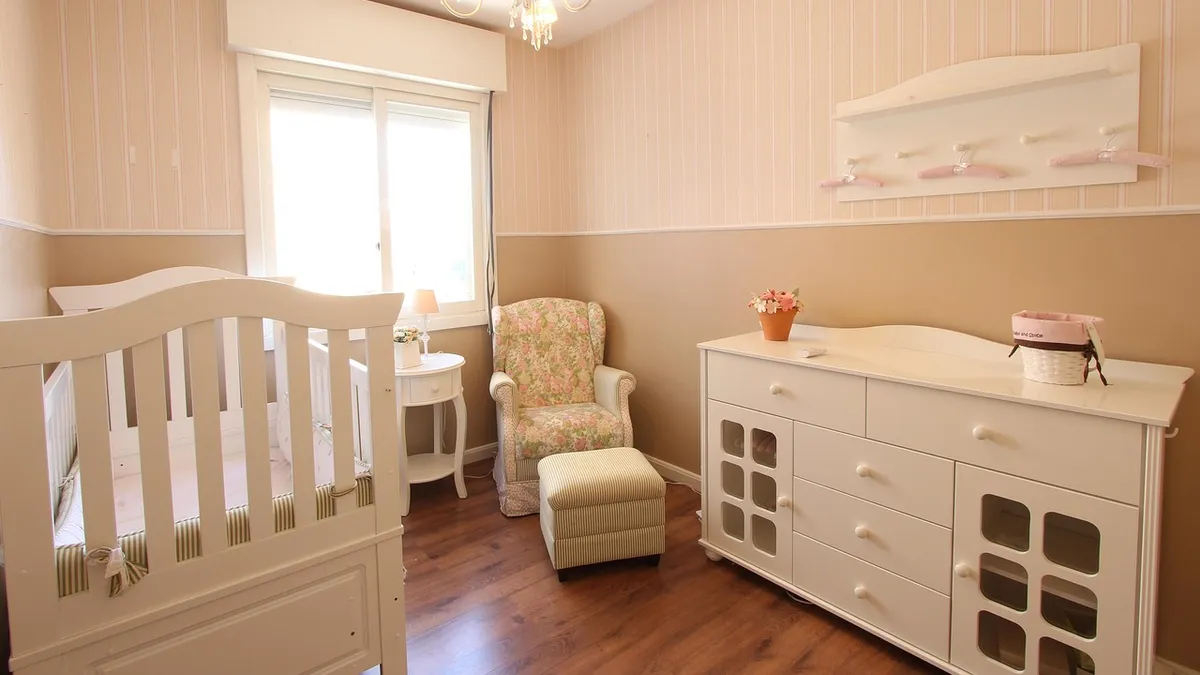
Put the unit on the floor or another stable, low surface — not a shelf, dresser top, or windowsill above or right beside the crib — several feet away, with its air intake and exhaust pointed away from where the baby sleeps rather than straight at the crib. That placement logic follows the same reasoning behind general crib-area safety: keep anything with moving air, a cord, or a hard edge out of the space immediately around where a baby sleeps or reaches.
The one placement number that is actually sourced is about the cord, not the unit itself. The CPSC’s own guidance on baby monitors is explicit: “Remember, at least 3 feet away is where your monitor should stay,” and the agency applies the same logic to lamp cords, telephone cords, and night light cords near a crib, because a child can wrap a reachable cord around their neck. There is no reason an air purifier’s cord should be treated differently — route it along the wall, away from the crib and out of reach, and avoid extension cords running across the floor where a crawling or standing baby could pull them.
As your baby grows into a pulling-up, cruising toddler, re-check the setup: anything reachable from inside or right next to the crib — cords included — needs to move further away, not just at newborn stage.
Is an ozone or ionizing air purifier safe for a nursery?
No. The EPA is direct about this: “No agency of the federal government has approved these devices for use in occupied spaces,” referring to ozone generators sold as air cleaners. Ozone is a lung irritant, and the EPA notes it can cause chest pain, coughing, shortness of breath, and throat irritation, and can worsen asthma and other respiratory conditions — even at concentrations some manufacturers claim are safe. The agency also found that ozone is largely ineffective at removing indoor air contaminants at the levels that meet public health standards.
Ion generators and some other electronic air cleaners produce ozone indirectly, not just devices explicitly branded as ozone generators, and the EPA warns that under certain conditions they can raise ozone to levels considered unhealthy. A nursery is a room a baby spends many hours in, awake and asleep, so it is worth checking a purifier’s specifications for any mention of ozone, ionization, or “activated oxygen” before buying, and choosing a true HEPA model without an ozone-producing ionizer instead.
How loud should an air purifier be during naps and at night?
Aim for the same ceiling either time of day: under roughly 30 dB(A) on whatever setting you actually use. The WHO’s noise guidance states that less than 30 A-weighted decibels in a bedroom at night supports good-quality sleep, with measurable sleep disturbance starting around that level and above. WHO’s guideline specifically addresses nighttime bedroom sleep; it does not publish a separate number for daytime naps. Because the purpose of the guideline — protecting normal sleep — applies whenever a baby is actually asleep, using the same ~30 dB(A) ceiling for naps is a reasonable rule of thumb, not an official WHO figure for daytime hours.
Correct sizing helps here too: a purifier whose CADR comfortably covers the room’s square footage can reach its target air changes per hour on a lower, quieter fan speed, rather than running flat-out around the clock. Look for the manufacturer’s published decibel rating at the lowest setting rather than marketing phrases like “whisper-quiet,” since that number is not independently standardized the way CADR is.
Nursery air purifier sizing and safety checklist
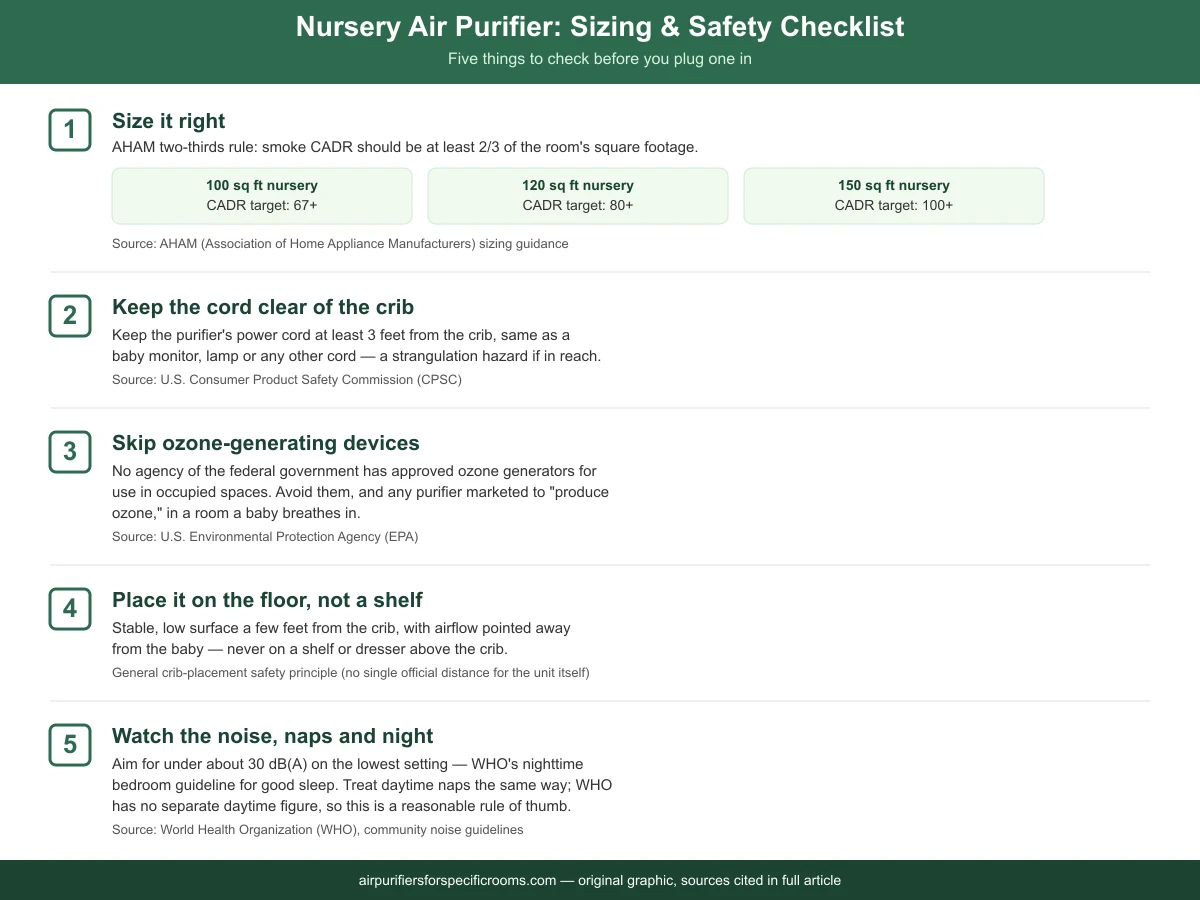
This checklist combines the sizing math and the three sourced safety rules above into one reference.
| Checklist item | What to do | Source |
|---|---|---|
| Size | Match smoke CADR to at least two-thirds of the nursery’s square footage (100 sq ft → CADR 67+; 120 sq ft → CADR 80+; 150 sq ft → CADR 100+) | AHAM |
| Cord | Keep the power cord at least 3 feet from the crib, same as a baby monitor, lamp, or night light cord | CPSC |
| Ozone | Skip ozone generators and any purifier that produces ozone; no federal agency has approved them for occupied rooms | EPA |
| Placement | Floor or a stable low surface, several feet from the crib, airflow pointed away from the baby — never on a shelf above the crib | General crib-area placement principle (no official distance exists for the unit itself) |
| Noise | Aim for under about 30 dB(A) on the lowest setting, for both naps and overnight | WHO (nighttime guideline; the daytime-nap figure is a rule of thumb, not a separate official number) |
Frequently asked questions
Is it safe to run an air purifier all night in a nursery?
Yes, a properly sized true-HEPA purifier without an ozone-producing ionizer is designed to run continuously. Choose a model whose published CADR matches the room’s square footage so it can run on a lower, quieter setting overnight, and keep the cord and the unit itself placed well away from the crib as described above.
How close can the air purifier be to the crib?
There is no single official distance for the unit’s body, but the cord is a different story: the CPSC specifically says to keep cords, including monitor and lamp cords, at least 3 feet from the crib because of strangulation risk, and that logic applies equally to an air purifier’s cord. For the unit itself, a stable low surface a few feet away, with airflow not aimed directly at the crib, follows the same general safety reasoning.
Are ionizing or ozone air purifiers safe for a baby’s room?
The EPA says no federal agency has approved ozone generators for use in occupied spaces, and that ozone can irritate the lungs and worsen asthma even at levels some manufacturers describe as safe. Ion generators and some other electronic air cleaners can also produce ozone indirectly. For a nursery, choose a true HEPA purifier and check the spec sheet for any mention of ozone or ionization before buying.
Will a correctly sized air purifier be too loud for naps?
Usually not, if it is sized to the room. AHAM’s guidance notes that a correctly sized unit can reach its target air changes per hour on a lower fan speed, which tends to be quieter than an undersized unit forced to run on high around the clock. Check the manufacturer’s published decibel rating at the lowest setting against the roughly 30 dB(A) guideline described above.
Sources
- U.S. Environmental Protection Agency, Guide to Air Cleaners in the Home — CADR-by-square-footage sizing chart and ceiling-height adjustment.
- Association of Home Appliance Manufacturers (AHAM), Tips for Choosing the Ideal Portable Room Air Cleaner — the two-thirds CADR-to-square-footage rule and noise guidance for correctly sized units.
- U.S. Environmental Protection Agency, Ozone Generators that are Sold as Air Cleaners — federal approval status, health effects, and effectiveness findings.
- U.S. Environmental Protection Agency, What Are Ionizers and Other Ozone Generating Air Cleaners? — how ion generators produce ozone indirectly.
- U.S. Consumer Product Safety Commission, Baby Monitor Cords: 3 Feet from Baby — the 3-foot cord-distance guidance and strangulation-risk rationale.
- World Health Organization, Noise fact sheet — the under-30-dB(A) nighttime bedroom guideline for good-quality sleep.
airpurifiersforspecificrooms.com Editorial Team. Last updated: November 12, 2026.

Related Posts
How to Size an Air Purifier for a Vaulted Ceiling Room
What Size Air Purifier Do You Need for a Garage Workshop?