Air Purifier Size by Room: Bedroom, Nursery, Basement & More
The answer depends on the room, not a single number. Start with the AHAM two-thirds rule: pick a purifier whose smoke CADR is at least two-thirds of the room’s square footage. Then adjust up for ceiling height, moisture, cooking smoke, or workshop fumes — the room types below each need a different target.
Key takeaways
- The baseline formula comes from AHAM (the Association of Home Appliance Manufacturers): smoke CADR should be at least two-thirds of the room’s floor area in square feet, which works out to about 4.8 air changes per hour on a standard 8-foot ceiling.
- The EPA’s Guide to Air Cleaners in the Home publishes a matching CADR-by-square-footage chart and notes that taller ceilings need a higher CADR than the chart shows.
- Some rooms need more than the baseline: AHAM recommends sizing to a 1:1 CADR-to-area ratio (not two-thirds) for wildfire-smoke-level pollution — a useful stand-in for any room with heavy smoke, mold spores, or fumes, such as a musty basement, a smoky kitchen, or a workshop.
- CADR alone does not solve every problem. The EPA says an air cleaner cannot remove gases or odors unless it has an activated carbon filter, and it cannot fix a mold problem caused by moisture — only reduce some of the airborne particles.
- Pick the room that matches your situation below for a full sizing walkthrough; this page covers the fast answer for all of them in one table.
What determines the right air purifier size?
Three numbers matter: the room’s square footage, its ceiling height, and the purifier’s Clean Air Delivery Rate (CADR) — a rating that measures how many cubic feet of filtered air the unit delivers per minute, separately for smoke, dust, and pollen particles.
AHAM’s two-thirds rule says to multiply the room’s square footage by two-thirds and look for a smoke CADR at least that high. A 200-square-foot room, for example, needs a smoke CADR of at least 132. The EPA publishes a very similar chart for the same purpose, built around an 8-foot ceiling.
Both organizations agree on one adjustment: a taller ceiling means more air volume, so a vaulted or high-ceilinged room needs a higher CADR than its floor area alone suggests. If that applies to your room, see how to size an air purifier for a vaulted ceiling for the adjusted math.
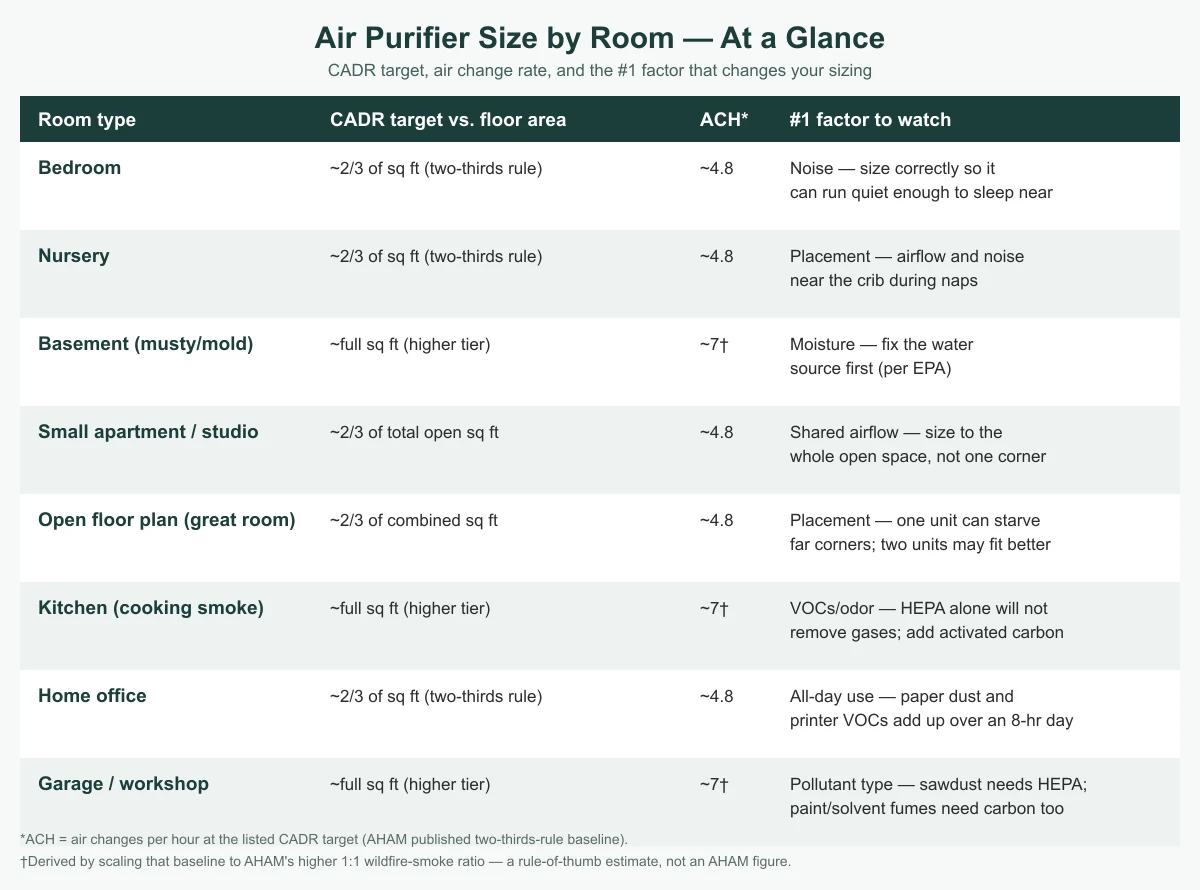
The master table: air purifier size by room type
This table applies the two sizing tiers above to eight common room situations. “Standard tier” uses AHAM’s two-thirds rule (about 4.8 air changes per hour). “Higher tier” uses AHAM’s 1:1 wildfire-smoke ratio, which this page applies to any room with a heavier pollutant load — musty basements, cooking smoke, and workshop fumes.
| Room type | CADR target vs. floor area | ACH* | #1 factor to watch |
|---|---|---|---|
| Bedroom | ~2/3 of sq ft (standard tier) | ~4.8 | Noise — the right size lets it run on a quiet setting overnight |
| Nursery | ~2/3 of sq ft (standard tier) | ~4.8 | Placement — airflow and noise near the crib during naps |
| Basement (musty smell/mold) | ~full sq ft (higher tier) | ~7† | Moisture — fix the water source first; a purifier only helps with airborne particles |
| Small apartment or studio | ~2/3 of total open sq ft (standard tier) | ~4.8 | Shared airflow — size to the whole open space, not just the sleeping corner |
| Open floor plan / great room | ~2/3 of combined sq ft (standard tier) | ~4.8 | Placement — one unit can starve far corners; two smaller units may cover better |
| Kitchen (cooking smoke) | ~full sq ft (higher tier) | ~7† | VOCs and odor — HEPA alone won’t remove gases; look for added activated carbon |
| Home office | ~2/3 of sq ft (standard tier) | ~4.8 | All-day use — paper dust and printer VOCs accumulate over a full workday |
| Garage or workshop | ~full sq ft (higher tier) | ~7† | Pollutant type — sawdust needs HEPA; paint or solvent fumes also need activated carbon |
*ACH: air changes per hour at the listed CADR target, from AHAM’s published two-thirds-rule baseline (about 4.8 ACH on an 8-foot ceiling). †Higher-tier ACH is a rule-of-thumb estimate: it scales AHAM’s 4.8 ACH baseline up to match AHAM’s 1:1 wildfire-smoke CADR ratio. AHAM does not publish this number directly — treat it as a starting point, not an exact figure.
Which room are you sizing for? A quick decision guide
Pick the description that matches your space, then open the full guide for exact numbers, placement tips, and the safety notes specific to that room:
- A bedroom you sleep in every night: What Size Air Purifier Do You Need for a Bedroom?
- A nursery with a crib: How to Size and Place an Air Purifier in a Nursery
- A basement that smells musty or has mold: How to Size an Air Purifier for a Musty Basement
- A small apartment or studio: What Size Air Purifier Do You Need for a Small Apartment or Studio?
- An open living/dining/kitchen area: One Big Air Purifier or Two Small Ones for an Open Floor Plan?
- A kitchen with cooking smoke and smells: What Size Air Purifier Do You Need for Kitchen Smoke?
- A home office you work in all day: What Size Air Purifier Do You Need for a Home Office?
- A garage or workshop with sawdust or fumes: What Size Air Purifier Do You Need for a Garage Workshop?
- A room with a vaulted or high ceiling: How to Size an Air Purifier for a Room With a Vaulted Ceiling
Why do some rooms need more CADR than others?
The two-thirds rule assumes an average pollutant load: everyday dust, pollen that drifts in, and normal skin and pet particles. That is a reasonable baseline for a bedroom, a home office, or a quiet living room.
Some rooms regularly have more to filter. AHAM’s own guidance calls out one specific case where the baseline should change: for wildfire smoke, it recommends sizing the purifier’s smoke CADR to roughly match the full room square footage — a 1:1 ratio instead of two-thirds. This page applies that higher tier to three other situations with a comparably heavy load: a basement with musty air or mold spores, a kitchen during and after cooking, and a garage or workshop with sawdust or fumes in the air.
In each of those higher-tier rooms, CADR alone is not the whole story. The EPA is specific that an activated-carbon filter — not a HEPA filter — is what removes gases and odors, and that it works best with a thick layer of carbon material. A purifier with HEPA only will capture particles like dust and smoke soot but will not pull cooking odors, paint fumes, or solvent vapor out of the air.
Does a musty basement need a bigger purifier, or a dehumidifier?
Often both, and in a specific order. The EPA’s guidance on mold is direct: solving a mold or musty-smell problem means finding and fixing the moisture source and cleaning up the mold that has already grown. A portable air cleaner is not a fix for a leaking wall, a wet floor, or damp framing — it can only reduce some of the mold spores and dust already floating in the air after the moisture problem is addressed.
Once the moisture source is under control, size the purifier using the higher tier above (close to the full room square footage) because a basement typically has a heavier particle load than an upstairs bedroom. For the full walkthrough — including when a dehumidifier should come first — see how to size an air purifier for a musty basement.
Can one air purifier cover an entire small apartment?
Sometimes, if it is sized to the whole open area rather than just the bedroom nook. A purifier filters the air in the room it sits in; it cannot reach air behind a closed door or down a separate hallway. In a true studio, where the sleeping area, living area, and kitchenette share one open volume, add up the full square footage and apply the two-thirds rule to that total, then place the unit where air can circulate across the whole space rather than tucked in a corner.
In a larger open floor plan — a connected living, dining, and kitchen area — the same math applies, but the right answer is sometimes two smaller units in different zones rather than one large unit in the middle. See one big air purifier or two small ones for an open floor plan for the placement tradeoffs, and sizing for a small apartment or studio for a worked square-footage example.
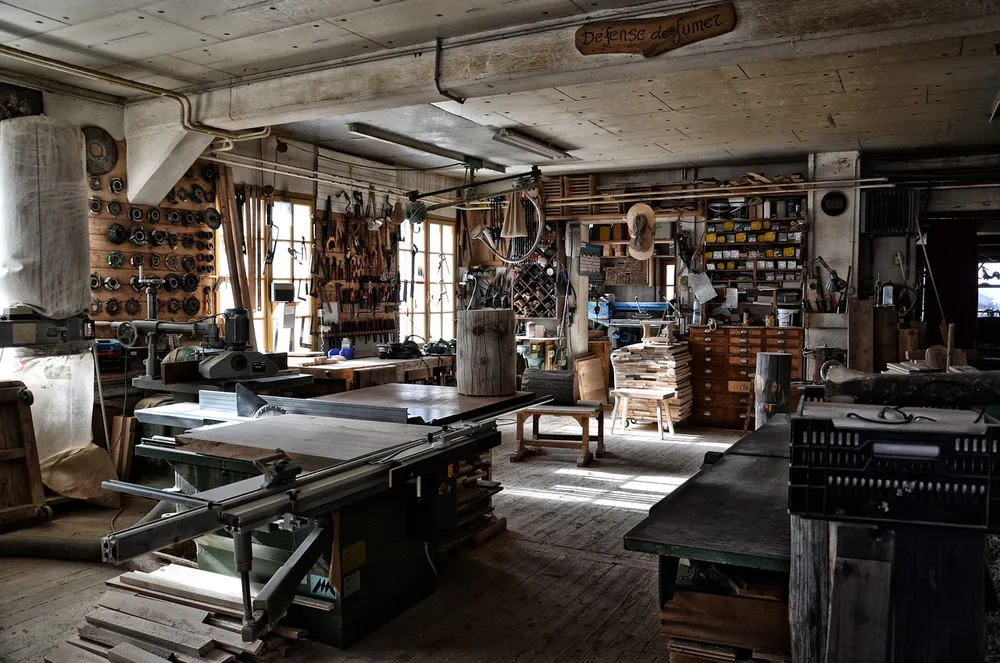
What’s different about sizing for a garage or workshop?
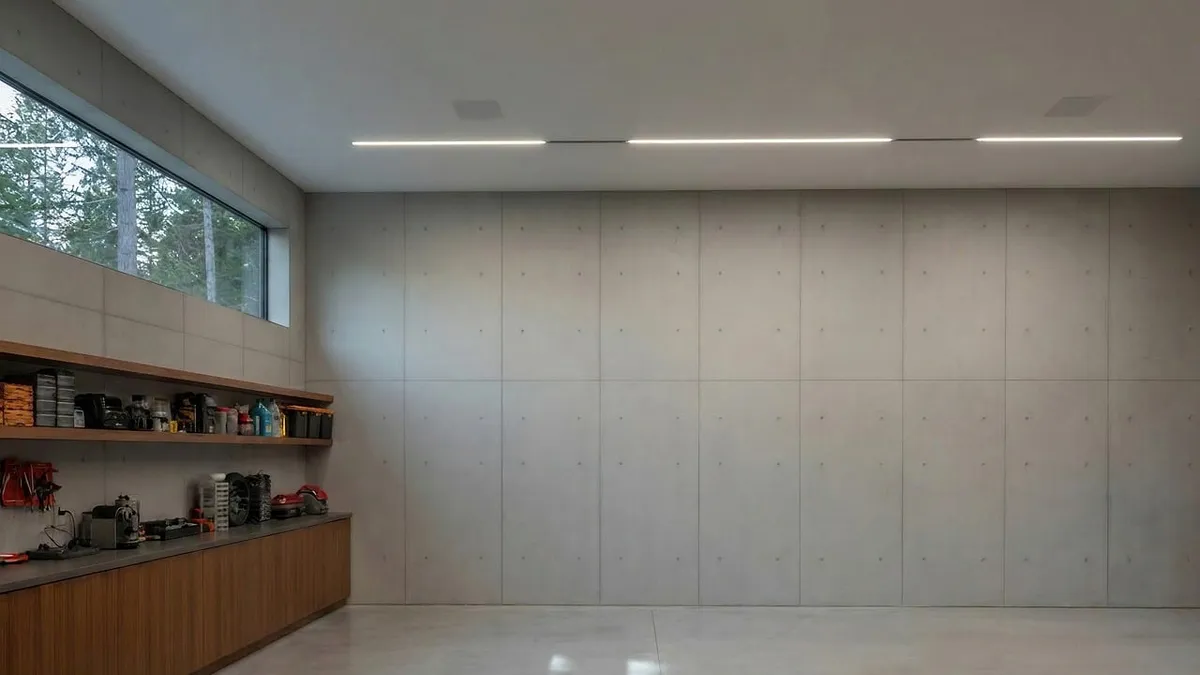
The right size depends on what is in the air. Sawdust and wood particles are solid particulates, so a properly sized HEPA-based purifier at the higher tier handles them the same way it handles smoke or dust in any other room. Paint, stain, solvent, or adhesive fumes are gases, not particles — the EPA’s guidance applies here too: only an activated carbon filter removes those, and the EPA notes a thicker carbon layer works better, which matters most in a workshop that uses solvents regularly. A garage with a car running or stored fuel also needs attention to ventilation, not just filtration; consider talking with an HVAC or indoor air quality professional if combustion fumes are a regular concern. For the full sizing table split by shop size and pollutant type, see sizing an air purifier for a garage workshop.
What should I do if my room has a vaulted or high ceiling?
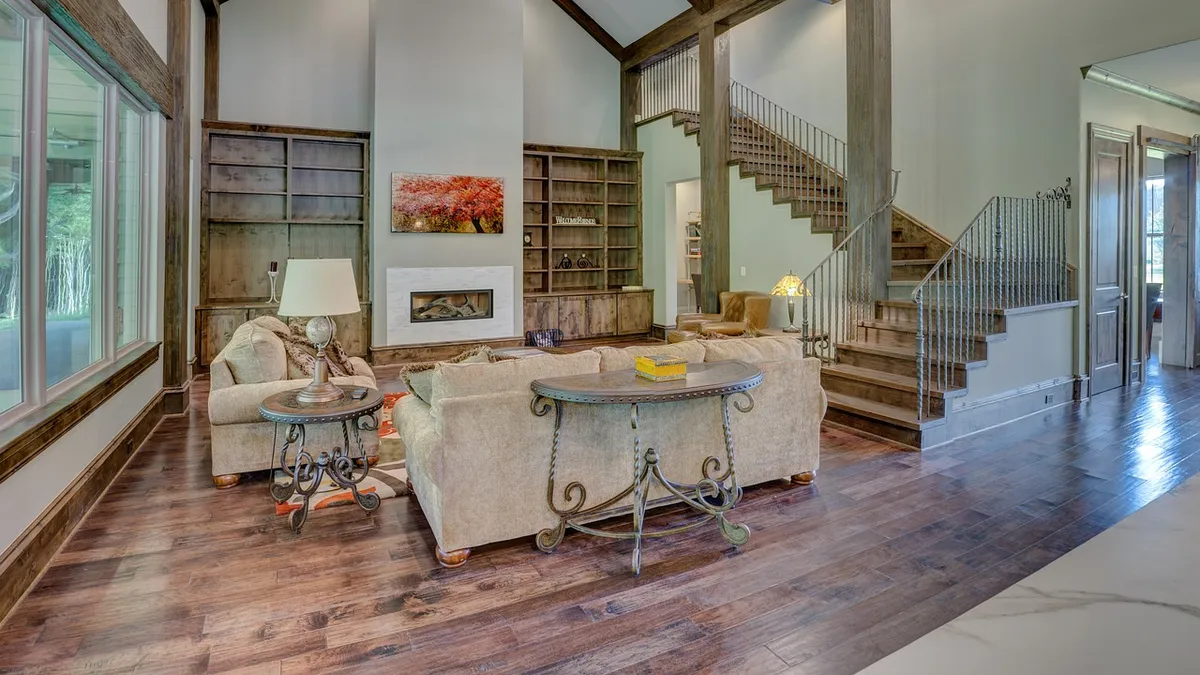
Size up. Both the EPA and AHAM calculate their CADR charts around an 8-foot ceiling. Basic volume math shows why that matters: a 10-foot ceiling holds about 25% more air than an 8-foot ceiling over the same floor area, and a 12-foot ceiling holds about 50% more — even though the floor area on a sizing chart looks identical. The EPA’s own guidance says to select a portable air cleaner with a higher CADR than the chart shows when ceilings are taller. For worked examples on a vaulted bedroom and a vaulted great room, see how to size an air purifier for a room with a vaulted ceiling.
Frequently asked questions
Is it better to buy an air purifier rated for a bigger room than I actually have?
A purifier rated somewhat above the minimum CADR for your room size is not wasted: it can clean the air faster and often runs quieter on a lower fan setting to hit the same air changes per hour. Going far beyond what the room needs mostly adds cost, size, and energy use without much extra benefit, so match the CADR to the room using the table above rather than buying the largest unit available.
Do I need a separate air purifier for every room in my house?
Not every room, but closed-door rooms with their own air quality concerns usually need their own unit. A purifier filters the air in the space it occupies; walls and closed doors block most of that filtered air from reaching other rooms. A common setup is one purifier for the primary bedroom (or nursery) and one for the main living area, sized separately using the table above for each room’s square footage.
Does a bigger CADR mean a louder air purifier?
Not necessarily at the setting you actually use. AHAM’s own consumer guidance notes that choosing a purifier properly sized for the space is the best way to keep noise appropriate, because a correctly sized unit can reach its target air changes per hour on a lower, quieter fan speed. An undersized unit forced to run on its highest setting around the clock is usually the louder choice.
Will a HEPA air purifier remove cooking smells and smoke from my kitchen?
A HEPA filter captures the solid particles in cooking smoke, but the EPA is clear that gases and odors need an activated carbon or other absorbent filter, not HEPA. For a kitchen, look for a purifier that combines true HEPA with a carbon filter layer, and size it to the higher tier in the table above since cooking produces a heavier particle and odor load than everyday room dust.
Can an air purifier fix a musty smell in my basement on its own?
Usually not by itself. The EPA’s guidance on mold states that controlling the problem means finding and fixing the moisture source and cleaning up existing mold — an air cleaner only reduces some of the particles already in the air afterward. If the basement still smells musty after the moisture source is fixed, a correctly sized purifier at the higher tier can help with any remaining airborne spores and odor.
Sources
- U.S. Environmental Protection Agency, Guide to Air Cleaners in the Home — CADR-by-square-footage chart, ceiling height adjustment, and activated carbon guidance for gases and VOCs.
- Association of Home Appliance Manufacturers (AHAM), Tips for Choosing the Ideal Portable Room Air Cleaner — the two-thirds rule, the 4.8 air-changes-per-hour baseline, the wildfire-smoke 1:1 sizing ratio, and noise guidance.
- AHAM Verifide, AHAM’s Air Filtration Standards — background on the CADR test standard.
- U.S. Environmental Protection Agency, A Brief Guide to Mold, Moisture, and Your Home — moisture-source-first guidance for musty and mold-affected spaces.
airpurifiersforspecificrooms.com Editorial Team. Last updated: November 12, 2026.

Related Posts
How to Size an Air Purifier for a Vaulted Ceiling Room
What Size Air Purifier Do You Need for a Garage Workshop?
3 thoughts on “Air Purifier Size by Room: Bedroom, Nursery, Basement & More”